Jacques Marquette and Louis Jolliet
Louis Jolliet and Father Jacques Marquette were one of the first explorers to explore the Mississippi. They were sent from New France to go as far south as possible to explore what the Native Americans called the “Great River”. Marquette was born in France while Jolliet was born in Canada. Both had reasons were for going. Jolliet wanted to expand his fur trade since he knew there was a lot of hides he can find and sell when he comes back. Marquette wanted to go since he felt the need to find tribes that would take on Christianity and convert them. Jolliet was chosen because he was the one to chart the maps since he studied hydrography. Marquette was important since he knew how to fluently speak 6 different Native American languages. Their findings have had a huge effect on the American history.
Louis Jolliet was commissioned by the governor of France to explore the Mississippi. The French thought that it would lead to the Pacific Ocean, and from there, they can travel west to Asia. The route was called the Northwest Passage. In May 17, 1673 a group of 7 men -Father Jacques Marquette, Louis Jolliet, and 5 voyagers- left St. Ignace with 2 Birch bark canoes. They had to travel from St. Ignace go acoss lake Michigan and then find their way to the Mississippi river. They only had 1 voyage, but that voyage is very important.
During their journey south they met up with many Native American tribes. 20 miles from the Arkansas River they stopped at Kappa, a Quapaw village. At first the village was reluctant to trust them but they eventually warmed up. They were the first Europeans there in over 100 years. After 3 days of feasting, the Quapaw gave the explorers a calumet, a ceremonial pipe, and Marquette regarded them as likeable and possibly future French allies and they put up a cross. The Quapaw warned the explorers than there were more Spanish settlements south. After that they went canoed across the state of Wisconsin to the Wisconsin River. They were flowing there until they reached the Mississippi. While they were there, they found out that the Mississippi went south to the Gulf of Mexico. They decided to turn back at the Arkansas since they encountered hostile Native American tribes and they feared they would meet Spanish soldiers.
Since Native American tribes were plentiful back then the two met a lot on their way. They first me a group of Illnois Indians called Quapaws. There they feasted for 3 days. Before they left the Quapaws gave Marquette a peace pipe and the explorers put up a cross in the center of the village. On their journey they also met other tribes. They also met the Iroquois. Before they went south of Arkansas friendly tribes warned them that Spanish soldiers were south. The part may not have survived if they did not meet up with the tribes.
After 5 months of exploration, the party turned back. They headed toward New France from Arkansas. They had trouble paddling upriver so they took advice form the Native Americans and traveled the Illinois River that led to Lake Michigan. Father Jacques Marquette got exceptionally ill so he had to encamp for winter. Marquette got better around 1974 but he died a few months later on May 18, 1975. His journal though got through and people learned about the journey and how the Mississippi was not the Northwest Passage. On the other hand Louis Jolliet lived on till the summer of 1700. He got what he looked for. He established a strong fur and fish trade in the St. Lawrence River. These two explorers will never be forgotten.
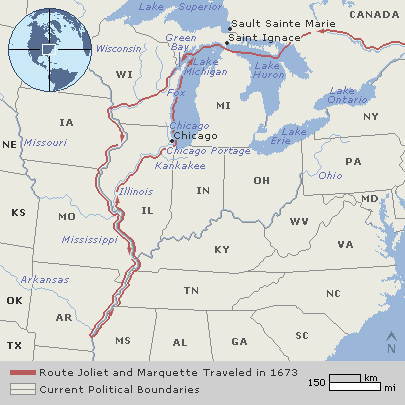
The route Jolliet and Marquette took to find and return from the Mississippi.
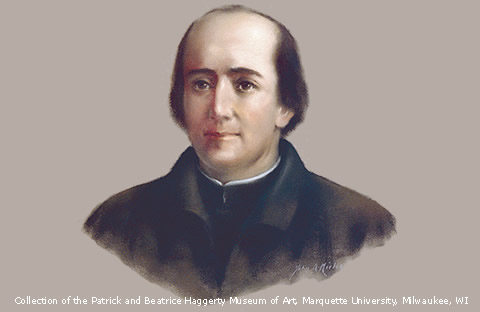
Father Marquette's portrait.
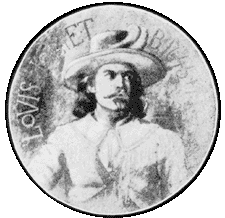
Louis Jolliet's face on a coin.
This page done by Ashen.
